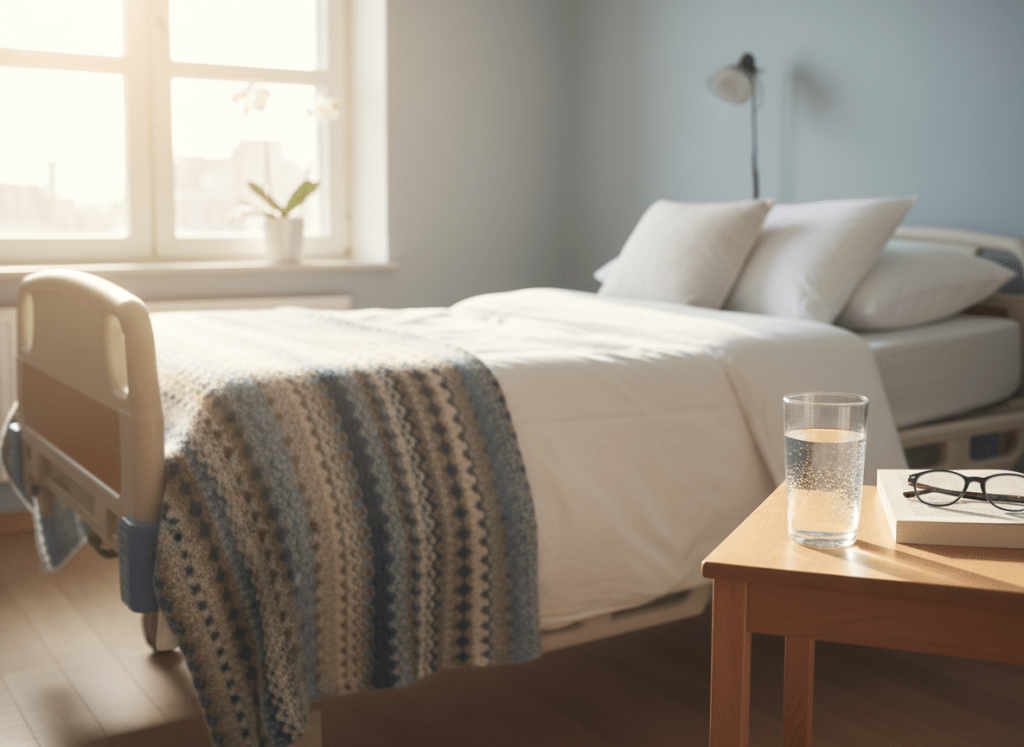
My Bed
Before my heart transplant, I never gave much thought to my bed. It was just where I slept, watched a little television, and occasionally argued with the fitted sheet.
Then I spent 67 days in the ICU waiting for a heart.
After that, my bed became sacred ground.
Hospital beds are incredible pieces of medical equipment. They go up, down, sideways, and into positions the human body was never meant to experience. Push the wrong button and suddenly your feet are higher than your head and you’re staring at the ceiling like an astronaut preparing for launch.
And let’s talk about comfort.
A hospital mattress feels like someone wrapped a yoga mat in plastic and called it therapeutic. Every time you move, it squeaks. Every time you sweat, you stick to it. By the third week, you’re not sleeping in the bed. You and the bed have entered into a hostile relationship.
Then there are the rails.
Those rails are supposed to keep you safe, but after a while, you start to feel like you’re sleeping in an adult crib. All I needed was a mobile hanging above me and somebody playing lullabies.
Of course, even if you do get comfortable, someone comes into the room.
“Mr. Hueston, are you sleeping?”
Not anymore.
They need your blood pressure. Then your temperature. Then some blood. Then another person comes in to ask if you’ve had a bowel movement. In the hospital, complete strangers are very interested in your bathroom habits.
Finally, the room gets quiet. You close your eyes and start drifting off.
BEEP.
You ignore it.
BEEP. BEEP.
A nurse comes in, pushes a button, and leaves.
Ten minutes later:
BEEP.
By the time I left the hospital, I could identify medical equipment by sound. I didn’t know what any of it did, but I knew which machine was annoying me.
Then came the glorious day when I finally returned home and saw my own bed.
I swear there was light shining down from heaven. I may have heard angels singing. Either that, or I was still hearing one of the IV pumps.
My bed looked enormous. Soft pillows. Real blankets. No plastic mattress. No rails. No buttons. No stranger coming in at 3:17 in the morning with a blood pressure cuff and a cheerful attitude.
I climbed into that bed and melted into it.
It felt like sleeping on a cloud, if clouds came with clean sheets and your wife beside you. Even my pillow smelled familiar. After weeks of hospital pillows that felt like folded bath towels, my own pillow felt like it had been custom-made by angels.
Honey probably wondered why I was so excited. To her, the bed had always been hers anyway. Jeri and I were simply allowed to use the remaining space.
That first night, I stretched out and thought, “This is heaven.”
Then Honey took her usual spot, leaving me approximately nine inches along the edge.
Still, it was my nine inches.
A long hospital stay changes what you appreciate. You become thankful for simple things: a quiet room, darkness, your own bathroom, a blanket that doesn’t have the texture of a moving pad, and a mattress that doesn’t automatically inflate beneath your backside every fifteen minutes.
My bed isn’t fancy. It doesn’t monitor my heart. It doesn’t raise my legs. It can’t call the nurse.
But it’s mine.
Now, every time I crawl into it, I remember those long nights in the ICU. I remember the beeping machines, the midnight blood draws, and trying to sleep while wearing enough wires to jump-start a pickup truck.
Some people dream of luxury hotels, expensive mattresses, and beds with adjustable settings.
Not me.
Give me my own bed, Jeri beside me, Honey stealing the blankets, and Charles’s heart beating quietly in my chest.
That’s my little piece of heaven.
Just don’t ask me to share my pillow. I’ve already given up most of the bed to the Chihuahua.
Frederick M. Hueston author of MY Heart Journey book series(7/23/26)


Leave a Reply