It Takes a Small Village
Have you ever wondered how many people it takes to give someone a heart transplant?
Before I went through it, I probably would have said a surgeon, a few doctors, and some nurses. Maybe somebody standing nearby holding a clipboard and looking serious.
I wasn’t even close.
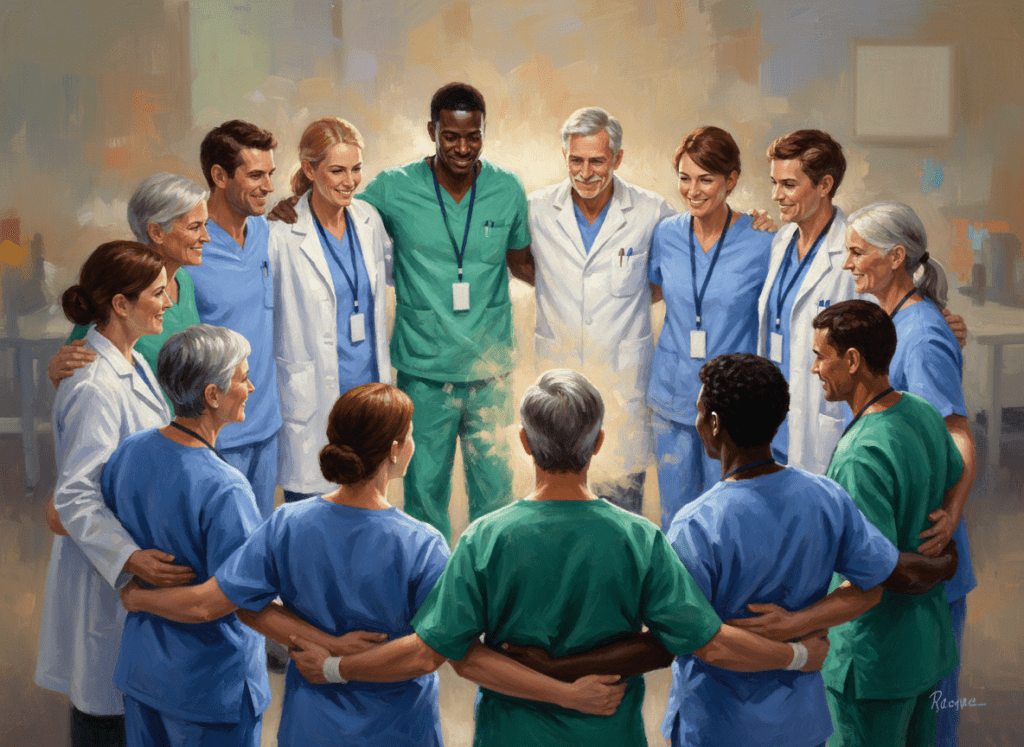
It takes a small village to perform a heart transplant. Actually, judging by the number of people who came in and out of my hospital room, I’m pretty sure it takes a small city. There may have been a mayor involved. If there was, I probably met him at three in the morning while he was drawing blood.
The doctors and nurses are certainly a huge part of it, but they are only the people you see most often. Behind them is an entire army of professionals, all working together to keep one person alive.
It begins with the transplant coordinators. These are the people who explain the process, arrange testing, answer questions, deliver updates, and somehow keep track of a mountain of information without their heads exploding. They speak several languages, including Medical, Insurance, Laboratory, and Frightened Patient.
Then there are the cardiologists, surgeons, anesthesiologists, intensivists, and other specialists. Each one studies a different part of you. By the time the evaluation is finished, there isn’t much left about your body that remains private. They know things about you that even your spouse doesn’t know, and your spouse already knows plenty.
There are laboratory technicians who draw enough blood to make you wonder whether they are testing it or opening a small blood bank in your name. There are imaging technicians who scan your heart, lungs, liver, kidneys, blood vessels, and probably your personality while they are at it.
There are pharmacists who study every medication you take, every medication you might take, and every medication you once looked at in a television commercial. After the transplant, they help manage the anti-rejection drugs, antibiotics, antivirals, blood pressure medications, and the rest of the little pills that eventually require their own suitcase.
There are dietitians who teach you what to eat, what not to eat, and how much sodium is hiding in food that doesn’t even taste salty. They are good people, but they have clearly never formed an emotional attachment to a bag of potato chips.
There are social workers who evaluate your support system, living arrangements, transportation, emotional health, and ability to handle the long recovery. They aren’t being nosy. They know that a transplant doesn’t end when the surgeon closes the incision. Someone has to help you get to appointments, organize medications, prepare meals, watch for symptoms, and stop you from doing something stupid because you suddenly feel better.
In my case, that person was Jeri.
The medical team may have replaced my heart, but Jeri helped keep the rest of me together. She kept track of medications, appointments, instructions, and all the things I was certain I would remember but didn’t. Every transplant patient needs a caregiver, and every caregiver deserves far more credit than they usually receive.
There are also physical therapists and cardiac rehabilitation specialists who get you moving again. At first, walking across the room can feel like competing in an Olympic event. They stand beside you, encourage you, and pretend not to notice that you are celebrating a trip to the hallway as if you just climbed Mount Everest.
There are respiratory therapists helping you breathe, technicians monitoring your heart rhythm, and staff members transporting you from one test to another. There are people sterilizing surgical instruments, maintaining equipment, cleaning rooms, changing linens, delivering meals, and making sure the hospital continues to function.
Housekeeping may not wear a white coat, but try running a transplant unit without them. Infection is a serious threat to transplant patients. A clean room isn’t just more pleasant. It can be a matter of life or death.
Somewhere beyond the hospital, another team is working with the donor and the donor’s family. Organ procurement professionals coordinate the donation. Recovery surgeons retrieve the organ. Couriers, drivers, and sometimes pilots help move it quickly because a donated heart doesn’t have the luxury of taking the scenic route.
Then the transplant center receives the call.
Suddenly, the entire village goes into motion.
Operating rooms are prepared. Blood is matched. Equipment is checked. Surgeons assemble. Nurses organize supplies. Anesthesiologists prepare medications. Perfusionists get the heart-lung machine ready. Coordinators make phone calls. Somewhere in the middle of all that activity, the patient is awakened and told, “We may have a heart for you.”
I say “the patient,” but in my case it was me.
After 67 days of waiting in the hospital, that call changed everything.
While I was being prepared for surgery, people I had never met were making decisions and completing tasks that would determine whether I lived. Many of them would never know my name. Some would never see me awake. Yet each person had a hand in giving me another day, another year, and hopefully many more years.
And none of it could have happened without Charles, my donor, and his family.
They were experiencing an unimaginable loss while I was being given another chance at life. Every person in the transplant village matters, but the gift begins with one donor and one family saying yes during the worst moment of their lives.
Today, when someone asks who performed my heart transplant, I could give them the surgeon’s name. But the more honest answer would be, “A whole lot of people.”
Doctors, nurses, coordinators, technicians, pharmacists, therapists, social workers, dietitians, cleaners, couriers, caregivers, and people behind the scenes whose names I may never know.
They didn’t all hold the scalpel. They didn’t all stand beside my bed. But every one of them helped get me here.
It takes a small village to give someone a new heart.
I’m just grateful that when I needed it, the whole village showed up.
Frederick M. Hueston, author of My Heart Journey Book Series. A list of all my books are at www.Fredssecondheart.com


Leave a Reply